
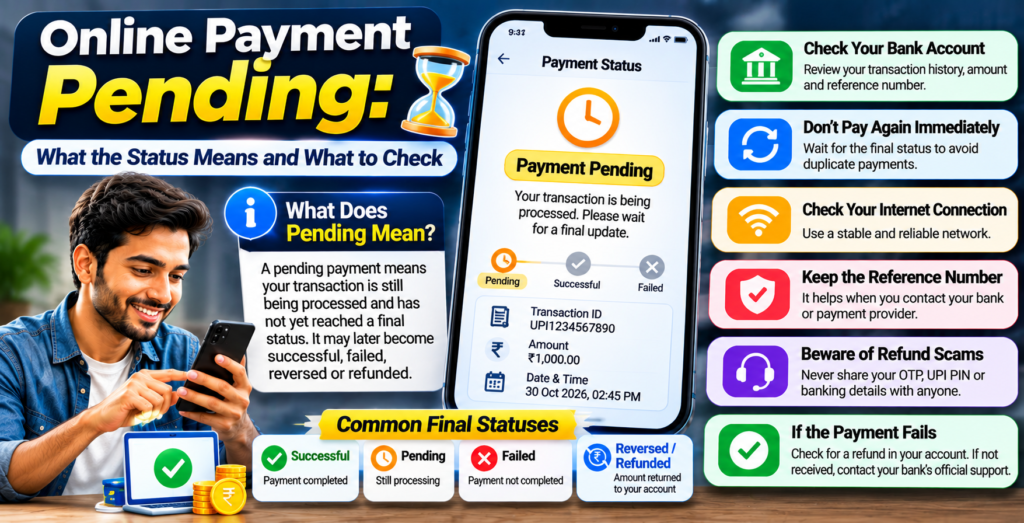
Seeing an online payment pending message can be confusing, especially when money appears to have been deducted from your bank account. A pending status generally means that the transaction has not yet received a confirmed final outcome.
The reason may involve delayed processing, a temporary network issue, or communication delays between the bank and payment provider. The exact resolution time depends on the payment method and the institutions involved. Instead of assuming that the payment has failed, check the transaction details and follow the appropriate steps.
1. Understand What a Pending Payment Means
A pending payment is a transaction whose final status has not yet been confirmed. Depending on the payment system, it may eventually become successful, failed, reversed, or refunded.
For example, a UPI transaction may remain pending while the relevant systems confirm whether the transfer was completed. During this period, the status shown by one application may not immediately reflect the latest information from another system.
Avoid making another payment immediately. First, check the original transaction to reduce the risk of duplicate payments.
2. Check Your Bank Account and Transaction History
If a payment is pending, open your official banking or payment application and review the transaction history.
Check the following details:
- Transaction date and time
- Payment amount
- Recipient or merchant details
- Transaction reference number
- Current payment status
Check whether the amount has been debited from your account. If it has, keep the transaction reference number available for future communication with your bank or payment provider.
Remember that a debit alone does not always confirm that the recipient has received the money.
3. Avoid Repeating the Payment Too Quickly
One common mistake is attempting the same payment again before confirming the original transaction’s status.
For example, a payment may appear pending in your application while the bank or payment provider is still processing the request. Making another payment during this period could result in two transactions being processed.
Wait for the original transaction’s status to become clearer. If the payment is urgent, contact the relevant bank or payment provider through an official channel before trying again.
4. Check Your Internet Connection
An unstable internet connection can interrupt communication between your device and a payment service. This may prevent the application from displaying the latest transaction information.
You can try reconnecting to a stable mobile data or trusted Wi-Fi network, reopening the payment application, and checking the transaction history again.
However, restoring your connection does not automatically resolve a pending transaction. Always verify the original payment status before initiating another transfer.
5. Keep Your Transaction Reference Number Safe
A transaction reference number helps the bank or payment provider identify the payment when investigating a problem.
Keep the reference number along with the transaction date, amount, and payment status. These details can make it easier to explain the issue when contacting legitimate support.
Avoid posting transaction details publicly on social media. Never share your UPI PIN, banking password, card PIN, CVV, or OTP with someone claiming to investigate the payment.
6. Watch Out for Payment and Refund Scams
Fraudsters may take advantage of payment delays by pretending to be bank representatives, merchants, or customer-support agents.
They might claim that they can release a pending payment or process a refund if you provide confidential information or install an application.
Do not follow these instructions. Never disclose your OTP or UPI PIN, and do not grant remote access to your device to an unsolicited caller.
Instead, contact your bank or payment provider through its official application, website, or verified customer-support channel.
7. What to Do If the Payment Fails
If the pending transaction eventually changes to failed or reversed, check your bank statement and payment history to determine whether the funds have been returned.
If the amount remains deducted despite an unsuccessful final status, contact your bank or payment provider. Share the transaction reference number and other relevant details through its legitimate support channel.
Processing and reversal times vary depending on the payment method and the institutions involved. Follow the guidance provided by your bank rather than relying on an assumed refund deadline.
Frequently Asked Questions
1. What does an online payment pending status mean?
It means the transaction has not yet reached a confirmed final status. The payment may still be processing or awaiting confirmation.
2. Should I make another payment while the first one is pending?
Not immediately. Check the original transaction and contact the relevant payment provider if its status remains unclear. This helps reduce the risk of duplicate payments.
3. What should I do if money has been deducted?
Check your bank statement and transaction history. Save the reference number and contact your bank or payment provider if the status remains unresolved.
4. Can a pending payment eventually become successful?
Yes. Depending on the payment system, a pending transaction may eventually be confirmed as successful or receive an unsuccessful final status.
5. What if the payment status changes to failed?
Check whether the amount has been returned or reversed. If the funds remain deducted, report the issue to the relevant bank or payment provider.
6. Should I share my OTP to receive a refund?
No. Never share an OTP, UPI PIN, or banking password with another person to obtain a refund.
7. What information is useful when reporting a pending payment?
The transaction date, amount, reference number, recipient details, and current status are generally useful. Provide them only through legitimate support channels.
8. How can I reduce online payment problems?
Verify recipient details before paying, maintain a stable connection, use updated payment applications, and check the original transaction before attempting another payment.