
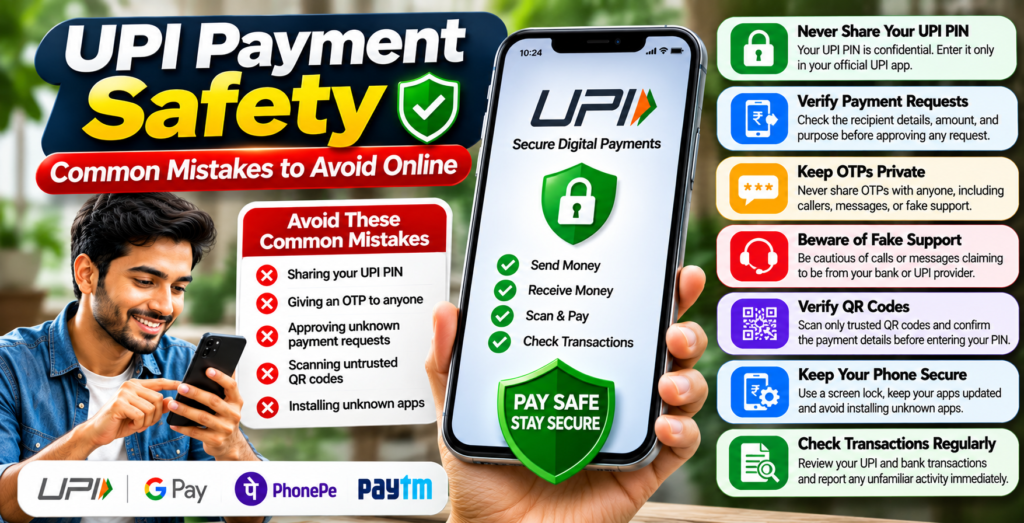
Unified Payments Interface (UPI) has made digital payments quick and convenient for millions of users in India. However, unsafe payment requests, fake customer-support calls, and careless handling of confidential information can expose users to financial risks.
Understanding UPI payment safety can help you recognize suspicious activity, protect your banking information, and make informed decisions before approving transactions. A few simple precautions can make everyday digital payments safer.
1. Never Share Your UPI PIN
Your UPI PIN is a confidential security credential used to authorize applicable transactions. Enter it only in your trusted UPI application when you understand and intend to approve the transaction.
Never disclose your PIN to a caller, stranger, or person claiming to represent a bank or payment service.
Be especially cautious if someone says you must provide your UPI PIN to receive money, process a refund, or resolve a failed payment. Never follow such instructions without independently verifying the situation.
2. Understand UPI Payment Requests
Before approving a UPI payment request, carefully check the recipient’s details, transaction amount, and purpose.
Scammers may send unexpected payment requests while claiming that approval is necessary to receive money or claim a refund. Remember that approving a payment request can authorize money to be transferred from your account.
If a request is unexpected or unclear, do not approve it. Confirm the details with the intended recipient through a trusted communication channel.
3. Keep OTPs Confidential
One-time passwords (OTPs) help verify certain transactions and account activities. Sharing an OTP with another person can compromise your security.
Never disclose OTPs through phone calls, WhatsApp messages, emails, or social media conversations. Genuine-looking messages can also be part of a scam.
If you receive an unexpected OTP, do not share it or approve an unfamiliar transaction. Check your account activity through your official banking or payment application.
4. Beware of Fake Customer Support
Fraudsters may impersonate bank employees, payment providers, merchants, or technical-support representatives. They might claim that your payment has failed or that your account needs immediate verification.
Their requests may include sharing your PIN, revealing an OTP, installing an unfamiliar application, or granting remote access to your phone.
Never follow instructions from an unsolicited caller without verifying their identity. Contact your bank or payment provider through its official website, application, or verified customer-support number.
5. Verify QR Codes Before Paying
QR codes are commonly used for digital payments, but scanning a code does not automatically make a transaction safe.
Before approving a payment, review the recipient’s name and the amount displayed in your UPI application. Confirm that these details match your intended transaction.
Do not enter your UPI PIN if the payment details are incorrect, unexpected, or unclear. Be cautious when someone pressures you to scan a QR code immediately.
6. Keep Your Mobile Device Secure
Your smartphone can contain banking applications, payment notifications, and other sensitive information. Protect it with a strong screen lock, PIN, or biometric authentication.
Keep your operating system and payment applications updated through official sources. Avoid downloading unfamiliar applications or granting unnecessary permissions, particularly to apps requesting access to sensitive information.
Never install remote-access software at the request of an unknown caller who claims to be helping with a payment issue.
7. Review Your Transactions Regularly
Checking your transaction history and bank statements can help you identify unfamiliar payments quickly.
If you notice a transaction you did not authorize, contact your bank immediately through an official channel. Follow its fraud-reporting procedure and keep relevant transaction details available.
In India, you can also report suspected financial cyber fraud through the official National Cyber Crime Reporting Portal or by calling the cybercrime helpline at 1930. Reporting promptly may help authorities take appropriate action, although recovery of funds is not guaranteed.
Frequently Asked Questions
1. Should I share my UPI PIN with customer support?
No. Your UPI PIN is confidential and should never be disclosed to customer-support representatives or other people.
2. Is it safe to share an OTP?
No. Never share an OTP with another person, even if they claim to represent your bank or payment provider.
3. Do I need my UPI PIN to receive money?
You should not need to enter your UPI PIN simply to receive money. Be cautious of anyone claiming otherwise.
4. What should I check before approving a UPI request?
Verify the recipient’s details, amount, and purpose. Decline unexpected or suspicious requests.
5. Are QR codes always safe?
No. Always verify the transaction details displayed by your payment application before authorizing a payment.
6. What should I do after an unauthorized transaction?
Contact your bank immediately through an official channel, report the transaction, and follow the bank’s instructions. In India, you can also call 1930 to report suspected financial cyber fraud.
7. Should I install an application recommended by a caller?
Avoid installing unknown applications at the request of an unsolicited caller. Use trusted application stores and verify the software’s legitimacy.
8. How can I improve UPI payment safety?
Keep your PIN and OTP private, verify every payment request, secure your phone, avoid suspicious applications, and review your bank transactions regularly.