
Here is the SEO-optimized article with approximately 650 words, including the meta title, meta description, primary keyword, secondary keywords, and FAQs.
Primary keyword: cricket terms
Secondary keywords: basic cricket terms, cricket terminology, cricket batting terms, cricket bowling terms, cricket scoring terms, cricket glossary
Meta title: Cricket Terms Explained: Complete Beginner’s Guide
Meta description: Learn essential cricket terms covering batting, bowling, scoring, fielding, match formats, and common odds terminology in this beginner-friendly guide.
Cricket Terms Explained: Batting, Bowling, Scoring and Common Market Terms
Cricket has its own vocabulary, and beginners may find terms such as innings, over, wicket, strike rate, run rate, and maiden over confusing. Understanding basic cricket terms makes it easier to follow live matches, scorecards, commentary, and match reports.
This beginner-friendly guide explains common cricket terminology across batting, bowling, scoring, fielding, match formats, and selected market terminology.
Basic Cricket Terms
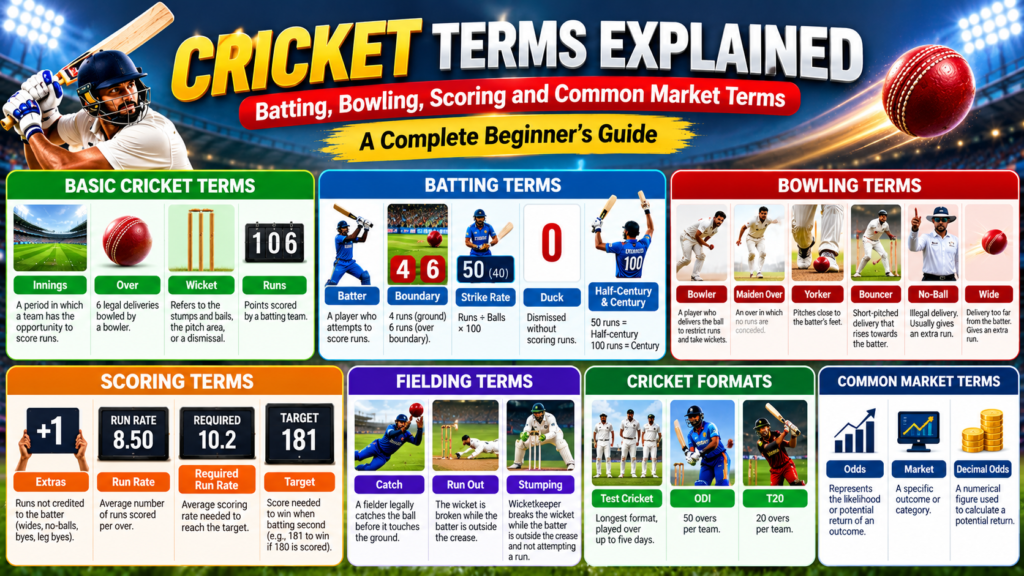
Innings: A period in which a team or batter has an opportunity to score runs. The number of innings and available overs depends on the match format.
Over: An over normally consists of six legal deliveries bowled from one end of the pitch.
Wicket: This term can refer to the stumps and bails, the pitch area, or the dismissal of a batter, depending on the context.
Runs: Runs are the points scored by a batting team through running between the wickets, boundaries, and extras.
Cricket Batting Terms
Batter: A player who attempts to score runs while facing the bowling side.
Boundary: A four is generally scored when the ball reaches the boundary after touching the ground. A six is generally scored when the ball clears the boundary without touching the ground inside the field.
Strike rate: Batting strike rate measures how quickly a batter scores.
Formula: (Runs scored ÷ Balls faced) × 100.
For example, 50 runs from 40 balls gives a strike rate of 125.
Duck: A duck means a batter is dismissed without scoring any runs.
Half-century and century: A half-century means scoring at least 50 runs in an innings, while a century means reaching 100 runs.
Cricket Bowling Terms
Bowler: A player who delivers the ball to restrict scoring and dismiss batters.
Maiden over: An over in which the bowler concedes no runs from the deliveries. Wickets may still fall during the over.
Yorker: A delivery that pitches close to the batter’s feet or the base of the stumps.
Bouncer: A short-pitched delivery that rises toward the batter after bouncing.
No-ball: An illegal delivery under the applicable cricket laws. It normally gives the batting team an extra run, and additional consequences may apply depending on the format.
Wide: A delivery judged too far from the batter to be a legitimate ball to play under the applicable rules. It normally adds an extra run and requires another delivery.
Cricket Scoring Terms
Extras: Runs added to the team total but not credited to an individual batter. Common examples include wides, no-balls, byes, and leg-byes.
Run rate: The average number of runs scored per over, calculated using the relevant completed overs and scoring rules.
Required run rate: The average scoring rate a team needs to reach its target within the remaining overs.
Target: The score a team needs to exceed to win when batting second. If the first team scores 180, the chasing team generally needs 181 to win.
Cricket Fielding Terms
Catch: A fielder catches the ball legally before it touches the ground after the batter has hit it.
Run out: A batter is run out when the wicket is legally broken while the batter is outside the relevant ground and attempting a run, subject to the laws.
Stumping: A dismissal that may occur when the wicketkeeper breaks the wicket while the batter is outside the crease and not attempting a run, subject to the applicable conditions.
Understanding Cricket Formats
Test cricket: The longest traditional international format, with matches scheduled for up to five days.
ODI: One Day International cricket, generally allowing each team a maximum of 50 overs.
T20: A limited-overs format in which each team generally has a maximum of 20 overs.
Common Market and Odds Terms
Some cricket-related coverage includes prediction or betting terminology. The meaning of these terms can vary by platform and jurisdiction.
Odds: Numerical figures associated with the likelihood or potential return of an outcome, depending on the market structure.
Market: A category of outcomes available for analysis or prediction.
Decimal odds: A format displaying a numerical figure used to calculate a potential return, subject to the applicable rules.
Readers should understand local laws and financial risks before using any betting-related service.
Frequently Asked Questions
1. What are the most basic cricket terms?
Common examples include runs, wickets, overs, innings, boundaries, extras, and strike rate.
2. What is an over in cricket?
An over normally consists of six legal deliveries bowled from one end.
3. What is a maiden over?
It is an over in which the bowler concedes no runs from the deliveries.
4. How is batting strike rate calculated?
Divide the batter’s runs by balls faced and multiply the result by 100.
5. What is the difference between a four and a six?
A four generally involves the ball reaching the boundary after touching the ground, while a six clears the boundary without touching the ground inside the field.
6. What are extras?
Extras are runs added to the team total rather than credited to an individual batter.
7. What is the difference between T20 and ODI cricket?
T20 teams generally have up to 20 overs each, while ODI teams generally have up to 50 overs each.
8. What does duck mean in cricket?
A duck means a batter was dismissed without scoring.